St. Peter's Orphanage
The Plot Against AmericaSt. Peter's Orphanage is both a place on the edge of Philip's Newark neighborhood and the refuge he imagines when he can no longer bear the danger facing his family. He tries to pass as an orphan so he can be taken in by the nuns; the institution's grounds then become the setting of his nighttime escape, his injury, and Seldon Wishnow's rescue of him. The orphanage matters not as a refuge he reaches, but as the destination around which his desperate plan—and its consequences—take shape.
Setting and Approach
The orphanage is associated with Lyons Avenue, where St. Peter's Church fronts the thoroughfare beneath its cross-capped steeple. Its grounds extend beyond the familiar streets into farmed acreage and woods, giving the institution a strikingly rural edge within Philip's Newark surroundings. On his second covert trip downtown, Philip takes the number 7 bus, whose route passes within roughly three-quarters of a mile of Summit Avenue and the orphan asylum's farmland. He chooses this approach because it is less likely to bring him past neighbors, schoolmates, or family friends who might recognize him.
The route makes the orphanage more than a distant idea: Philip studies the landscape around it as he moves toward it. At the Lyons Avenue bus stop, he waits beside two nuns in the traditional habits he has rarely had an opportunity to examine so closely. He assumes they are among the women who supervise the orphans and teach at the parochial school. Their quiet presence draws his curiosity even as he is intent on his secret errand. When one calls him a well-scrubbed, cute little boy, the ordinary kindness of the encounter sharpens the contrast between the child she sees and the orphan identity he hopes to assume.
The Orphanage as an Imagined Refuge
Philip's intended escape is deliberate, not a game or an impulsive act. With his father no longer able to protect the family against government-backed upheaval, Philip concludes that someone must act. He does not want to imitate Sandy Roth's desire to take part in history; instead, he wants the smallest possible escape from it. Becoming an orphan, in his imagination, means leaving a threatened household and entering a life beyond its reach.
Before the attempt, he practices this identity at a downtown theater screening a film about the White House guest. When the ticket seller refuses to admit an unaccompanied child, Philip claims to be an orphan living at St. Peter's Orphanage and says a sister has sent him to write a report on President Lindbergh. He presents a permission note he has forged in the name of Sister Mary Catherine. The ticket seller accepts it without reading it, and Philip gets inside. That successful deception briefly lets the orphanage function as an identity he can put on and use, even though he has not entered the institution or been taken in by its nuns.
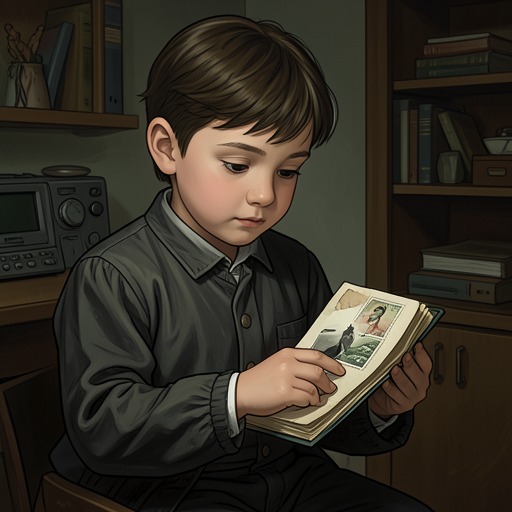
At home, he prepares for the more consequential version of the plan. He changes into Seldon's clothes, hoping to arrive as a familyless child, and takes his stamp album, the possession he cannot bear to leave behind. The account later establishes that his destination was to be the orphanage and that he hoped the nuns would take him in. The institution thus represents a radical break from family life, but Philip's plan depends on being recognized as someone who has no family at all.
Grounds, Accident, and Rescue
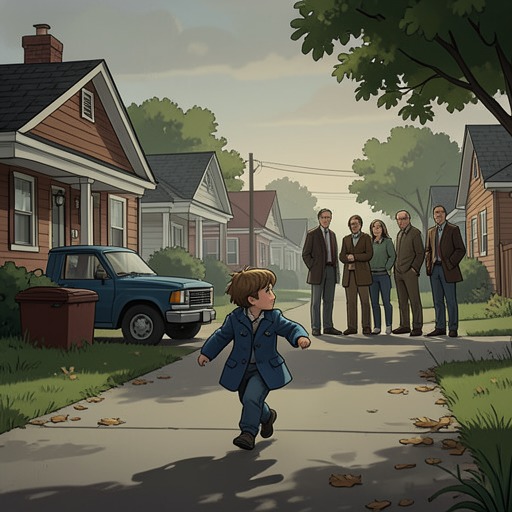
Philip sets out at night and reaches the grounds through the area around Summit Avenue, the high school playing field, and the Goldsmith Avenue side of the orphanage. Seldon, who has heard him coming down the back stairs, follows him in the dark. He passes through an unlatched gate into the orphanage woods, carrying his own secret hope of escaping notice even as Seldon keeps watch from a distance.
Where the woods open into the farming field, Philip becomes disoriented and startles the orphanage's two horses. As he tries to get away from them and back toward the street, one horse rears; he trips, and the other, fleeing, strikes the back of his head with a hoof. He is left bleeding and unconscious in Seldon's clothes. The acreage that seemed to offer a passage out of ordinary life has instead become a dangerous place to move through in the dark.
Seldon runs back to the Roth home, wakes Philip's parents, and guides them to the spot. Near three in the morning, in the darkness, Bess presses a towel to Philip's head while Herman covers him with an old picnic blanket from the car and waits for an ambulance. Philip has a concussion, a three-inch cut requiring eighteen stitches, and no memory of the blow or the sequence that led to it. Seldon's decision to follow him through the gate is decisive: Philip's parents organize the rescue, but Seldon saves his life.
Narrative Significance
Afterward, Seldon recounts the attempted runaway to Philip and to the school, especially the collision with the workhorses and his own barefoot, pajama-clad journeys across the rough mile between the orphanage woods and home. He takes pride in having uncovered the mystery of his missing clothes and in having become both rescuer and co-conspirator. The institution's grounds therefore become the setting for a change in Seldon's sense of his own importance as well as for Philip's injury and humiliation.
For Philip, the failed attempt carries a different aftermath. He is ashamed of what happened, and the stamp album he took with him is gone. St. Peter's Orphanage remains the unrealized destination of his escape: its nuns and grounds supplied the shape of a life he thought he could enter, but they could not remove the dangers from which he was fleeing. The contrast between imagined asylum and exposed farmland gives the episode its force. Philip seeks to disappear into the category of an orphan, yet the people whose care saves him are his family and the boy he had unknowingly made part of his flight.